Monday, October 5, 2020

What to Remember When Hosting Gatherings

Received this email from a friend? Sign up now

October 05, 2020
This message includes updates on the COVID-19 response from CDC. The COVID-19 Outbreak is a rapidly evolving situation and information will be updated as it becomes available.
a doctor in PPE checking a patient's fever reading

Emergency Warning Signs of COVID-19

If you notice any of these emergency warning signs for COVID-19, seek emergency medical care immediately:

• Trouble breathing
• Persistent pain or pressure in the chest
• New confusion
• Inability to wake or stay awake
• Bluish lips or face.
This list doesn’t include all possible symptoms. Call your medical provider for any other symptoms that are severe or concerning to you.
stay home, stay safe

Stay Home if You Might Have Been Exposed to COVID-19

People who have been in close contact with someone who has COVID-19 should stay home (quarantine) unless they’ve already had COVID-19 within the past 3 months. You were in close contact if you were within 6 feet of someone who has COVID-19 for a total of 15 minutes or more, you provided care at home to someone who is sick with COVID-19, you had direct physical contact with the person (hugged or kissed them), you shared eating or drinking utensils, or someone sneezed, coughed, or somehow got respiratory droplets on you.

a doctor in PPE holding up a lung xray

Long-Term Effects of COVID-19

As the pandemic unfolds, CDC is learning more about the many organs besides the lungs that are affected by COVID-19. One of the health effects that CDC is closely working to understand relates to COVID-19 and the heart. Heart conditions associated with COVID-19 include inflammation and damage to the heart muscle itself, known as myocarditis, or inflammation of the covering of the heart, known as pericarditis. The risk of heart damage may not be limited to older and middle-aged adults. For example, young adults with COVID-19, including athletes, can also suffer from myocarditis.
coronavirus travel restriction airport sign

Travel During the COVID-19 Pandemic

Travel increases your chance of getting and spreading COVID-19 and staying home is the best way to protect yourself and others from COVID-19. Before you travel, consider whether COVID-19 is spreading at your destination. The more cases at your destination, the more likely you are to get infected during travel and spread the virus to others when you return. If you do travel, take steps to protect yourself and others during your trip including wearing a mask, avoiding close contact, washing your hands often, and avoiding contact with anyone who’s sick.

halloween cookies

What to Remember When Hosting Gatherings This Holiday Season

If you’re planning on hosting a gathering over the holidays, remind guests to stay home if they’re sick or have been exposed to COVID-19 in the last 14 days. Host the gathering outdoors, when possible, and make sure indoor spaces are well-ventilated (for example, open a window). Arrange tables and chairs to allow for social distancing among people not in the same household. Wear masks when less than 6 feet apart from people or indoors, and encourage guests to bring their own food.

Coronavirus Disease 2019 (COVID-19) in the U.S.

As of October 05, 2020

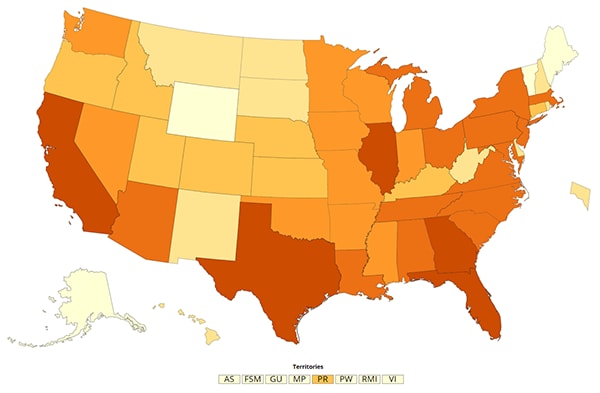
In the United States, there have been 7,396,730 confirmed cases of COVID-19 detected through U.S. public health surveillance systems in 50 states and the District of Columbia, Puerto Rico, Guam, the Northern Marianas Islands, and U.S. Virgin Islands. 

CDC provides updated U.S. case information online daily.

This map shows COVID-19 cases reported by U.S. states, the District of Columbia, New York City, and other U.S.-affiliated jurisdictions

Centers for Disease Control and Prevention

1600 Clifton Rd   Atlanta, GA 30329   1-800-CDC-INFO (800-232-4636)   TTY: 888-232-6348
Questions or Problems  |  Unsubscribe

Friday, October 2, 2020

WHO Health Emergency Highlights #108

View this email in your browser
120 million COVID-19 rapid antigen tests for low- and middle-income countries
With results available in 15-30 minutes, the use of these tests will help particularly in countries that do not have extensive laboratory facilities or trained health workers to implement molecular (PCR) tests.
Statement
"WHO has zero tolerance policy on sexual exploitation and abuse"
WHO is outraged by recent reports of alleged sexual exploitation and abuse in the Democratic Republic of the Congo (DRC). Such acts of abuse are not tolerated in any of our staff, contractors or partners; and anyone involved will be held to account and face serious consequences. WHO's Regional Director for Africa expressed support to the victims, and the decision of the Director-General to initiate a thorough review of the allegations and bring the perpetrators to account. The full statement is here.
Refugee scholarship for those displaced due to the conflicts
The Center for Humanitarian Health announced a refugee scholarship programme in honour of the late Dr Peter Salama, who was WHO's Executive Director of the Division for Universal Health Coverage. The grant will support individuals who have been displaced due to the conflicts in Afghanistan, Myanmar, South Sudan, Syria, and Venezuela. These students will receive full tuition while pursuing a Master of Public Health degree at the Johns Hopkins Bloomberg School of Public Health. Details are available on the Center's website. 
Thailand | Video
"It's so much easier to fight an epidemic like COVID-19 when you have a strong health system," says Dr Daniel Kertesz, WHO Representative in Thailand, lauding the country's decades of committing to and investing in the public health care system. Watch this video to learn how Thailand stayed ahead of the pandemic.
Greece
WHO deploys help to refugees and migrants in Lesvos's fire-burned camp
Hours after the catastrophic fire that broke out in the Moria reception and identification centre for asylum seekers and refugees in Lesvos, the WHO Country Office in Greece arrived on the island to working at the forefront of the response with government and other health actors.
The Americas
'Our fate is in your hands': Educating children on preventing Zika
The Pan-American Health Organization and UNICEF have teamed up with Cartoon Network Latin America in the "Mission Zika" educational campaign, to raise awareness about Zika using public service announcements on how to prevent the disease. The campaign calls on children – 'young superheroes' – to help stop the spread of the virus and protect themselves, their families and neighbourhoods.
Zambia
WHO supports home-based strategy to relieve health facilities
A successful pilot project to ensure effective care at home is being adopted across the country.
Democratic Republic of Congo
WHO in Africa strengthens cross-border surveillance
Faced with high risk of the spread of Ebola virus disease between from the Democratic Republic of the Congo (DRC) to the Republic of Congo (RC), WHO's Regional Director for Africa facilitated an agreement between the two countries on mechanisms of cross-border collaboration. The partnership strengthens surveillance, rapid case detection and multi-disciplinary interventions for Ebola in high-risk districts to prevent any importation of the virus into neighbouring countries.
Somalia
EU and WHO deliver emergency life-saving supplies to flood-affected areas
At the request of WHO, the European Union delegation to Somalia commissioned two special flights in September to airlift emergency medical kits and supplies to Hirshabelle State. These supplies are being used to treat populations affected by recent flash floods.
Philippines
Nationwide measles campaign to start in October
In the Philippines, around 2.4 million children under the age of five are susceptible to measles. WHO and UNICEF are supporting the Department of Health in the nationwide measles and polio supplemental immunisation campaign starting on 26 October.
Lao People's Democratic Republic
Expanding the COVID-19 surveillance system
Once a possible case or cluster is identified, an expanded community-based system alerts the surveillance team. The team can then quickly investigate, isolate, test and treat the cases and monitor and quarantine contacts to reduce chances of further transmission.
Indonesia
Life-saving antitoxin delivered to treat children with diphtheria 
Despite COVID-19 related disruptions to essential health services, WHO is supporting national authorities to continue immunisation services for vaccine preventable diseases, including diphtheria, which has a higher mortality rate among children. 
Global
HIV prevention in high burden settings through voluntary medical male circumcision
New WHO guidelines present additional evidence supporting voluntary medical male circumcision (VMMC) as part of a combination of preventive measures to keep adult men and adolescent boys from contracting HIV. The guidelines also outline a health systems framework to help transition to adolescent-focused sustainable services and maintain high VMMC coverage.
Spotlight on health care workers
COVID-19 has infected at least 570,000 health workers and killed 2,500 in the Americas
As of September, the Americas region has the highest number of health care workers infected in the world, with at least 570 000, and more than 2,500 have fallen – and still counting. With the region accounting for half of the world's COVID 19 cases, the scale of this pandemic is unprecedented. No other group has felt this more acutely than the very men and women who make up the health workforce, according to PAHO Regional Director Dr Carissa Etienne.
The Partners Platform
Live digital space behind the scenes for a more effective and transparent country response
The COVID-19 Partners Platform gives real-time monitoring of the flow of contributions in support of country-level response. Its action checklist, resource tracking and the Supply Portal, enable countries to choose actions from the checklist and create their preparedness and response plan, and match with donors. 
First WHO training in infodemic management
Four-week training in November now open for applications
Along with the COVID-19 pandemic, there is also an urgent need to address the misinformation around the disease, treatments and vaccines, and public health measures. WHO and partners invite applications from experienced professionals from the fields of epidemiology, risk communication, health service delivery/health care workers, digital health, policy making (in health and intersectoral), who are responding to the current COVID-19 and overlapping infodemics at country level.
It's never been more urgent to be part of the global COVID-19 response. Donations support the work with partners to track and understand the spread of the virus; ensure patients receive care and frontline workers get essential protection and information; and accelerate research and development of a vaccine and treatments for all who need them. Donate now.
 
Subscribe to the Health Emergency Highlights

www.who.int/emergencies

Copyright © 2020 World Health Organization, all rights reserved.

Would you like to change how you receive these emails?
Update your preferences or unsubscribe from this list


Update your preferences

  ...